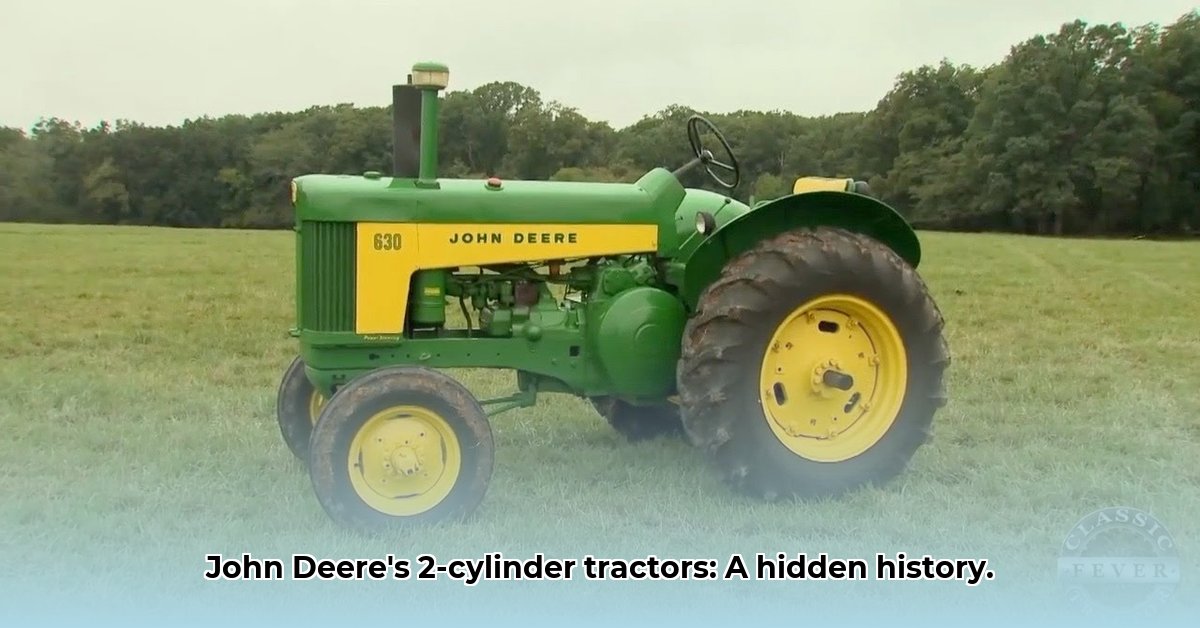
The story of John Deere's two-cylinder tractors isn't merely about machines; it's a narrative woven from American ingenuity, evolving agricultural practices, and the enduring legacy of dependable farm equipment. This journey begins, surprisingly, not with John Deere himself, but with another company entirely. For more in-depth information on early models, visit this helpful resource.
The Waterloo Boy: A Legacy's Genesis
Before the iconic green and yellow, there was the Waterloo Boy. Manufactured by the Waterloo Gasoline Engine Company, this robust tractor wasn't just a machine; it revolutionized farming. Imagine the backbreaking toil of pre-tractor agriculture—plowing, planting, harvesting—all done manually or with animal assistance. The Waterloo Boy, with its powerful two-cylinder engine, offered a transformative increase in efficiency and a reduction in arduous labor. John Deere's shrewd acquisition of the Waterloo Gasoline Engine Company in 1918 strategically incorporated this foundational technology. Consider the Waterloo Boy the patriarch of all subsequent John Deere two-cylinder tractors—a resilient, dependable workhorse establishing the foundation for future advancements. How did this simple machine change the course of farming history? Its impact was profound and far-reaching.
Early Models: Simple Power, Enduring Reliability
Early John Deere two-cylinder tractors, in contrast to modern machinery, were remarkably simple. They lacked the sophisticated features of today's technology. Yet, this simplicity was a source of strength. These weren't flashy machines; they were tools built for unwavering dependability and tireless work. Farmers prized this reliability above all else. These tractors, unassuming in appearance, significantly enhanced agricultural productivity. Their dependability cemented the John Deere name, a reputation that persists to this day. The sheer power they delivered was revolutionary for farmers accustomed to traditional methods. Did this simplicity translate to limitations? Surprisingly, no.
Fueling Progress: Kerosene to Distillate
A fascinating aspect of these tractors' history is their fuel source. Initial models often utilized readily available kerosene. However, as technology advanced, John Deere transitioned to distillate fuel. This wasn't a trivial change; it reflected progress in both engine design and fuel refinement, showcasing the adaptive nature of the tractors themselves. This flexibility mirrored the adaptability of the farmers who used them, ensuring their continued relevance. This adaptability to evolving technologies and resource availability ensured the tractor's longevity. What does this say about the ingenuity of the engineers? It points to a deep understanding of farmer's needs.
Design Evolution: From Three to Four Wheels
The design of John Deere two-cylinder tractors also underwent a significant transformation. Early models featured a three-wheel design—two rear wheels and a single front wheel. Later models, in direct response to farmer feedback, adopted a more stable and maneuverable four-wheel configuration. This wasn't merely an aesthetic shift; it showed a keen understanding of varied terrains and farming practices. This iterative improvement demonstrates a commitment to user needs. Why was this change so significant? It improved safety and operational efficiency.
A Legacy's End, But Not its Impact
Production of these workhorses concluded in the early 1960s, as more powerful machinery entered the market. While their reign ended, their legacy remains impactful. These tractors fundamentally altered agricultural practices for countless farmers. Their robust design and relatively simple mechanics resulted in low maintenance costs, a crucial advantage in an era before readily available specialized repair services. This inherent simplicity is a testament to excellent engineering—efficient, durable, and supremely effective. What lasting impression did these tractors leave on the agricultural world? One of unwavering reliability and efficiency.
Sustainable Agriculture: An Unanticipated Legacy
Interestingly, these older tractors can be viewed through the lens of modern sustainable agriculture. Compared to later models, their fuel efficiency is remarkable. They often accomplished similar tasks using less fuel, resulting in lower operating costs and a smaller environmental footprint. Their relative simplicity also meant fewer parts needed replacement, further minimizing their overall environmental impact. While seemingly humble by today's standards, their reduced energy consumption and lower maintenance needs make them surprisingly relevant in our increasingly environmentally conscious era. How did this unexpected legacy come to light? Through a re-evaluation of their design in the context of modern sustainability initiatives.
More Than Machines: Symbols of Progress
John Deere two-cylinder tractors are more than just farm equipment; they embody innovation, resilience, and adaptation. They represent a pivotal moment in agricultural history—the widespread adoption of mechanization and a crucial step in farming's evolution. Their story highlights the ingenuity of both the engineers and the farmers who utilized them, transforming how we cultivate our food. Their lasting legacy isn't just about horsepower or technological advancement; it's a human story of progress and adaptation. What larger narrative do they represent? One of triumph over challenges and the power of collaboration.
How Early John Deere Tractor Designs Impacted Modern Sustainable Farming
Key Takeaways:
- Early John Deere two-cylinder tractors unexpectedly laid the foundation for modern sustainable farming practices.
- Their design influenced fuel efficiency improvements in subsequent generations, lessening agriculture's environmental impact.
- Their reliability and adaptability facilitated widespread mechanization, increasing yields while reducing labor demands.
- Innovations in these early tractors shaped the evolution of power take-off (PTO) systems, enabling the use of diverse implements crucial for precision farming.
This examination of John Deere's two-cylinder tractors reveals a rich history of innovation and adaptation within the context of sustainable agriculture. Their legacy extends far beyond their operational lifespan, profoundly impacting the way we cultivate our world's food supply.